The Woman in Room Nine: THE NINTH ROOM by William Gomes
THE NINTH ROOM begins with a report that survives exactly as long as it takes to cross a room. “Anya Keel called Room Nine empty, and for the few seconds it took Lena Harrow to cross from the door to the bed she believed her.” No alarm, no search: a nurse’s words, and a doctor walking towards a bed. By the time Dr Lena Harrow reaches it, she knows what the room is telling her. The patient is gone. And the bed she slept in has been made, beautifully, by somebody else.
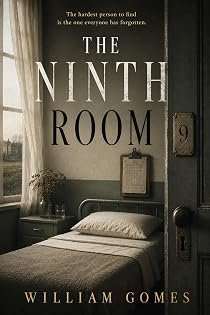
Pearl is seventy-one, a patient at Marle House, a private clinic of forty beds on the northern edge of the city. She had had no visitors in eleven days. Her observations were taken at half past two on the day she disappeared, and everything was as it should be. What Lena finds is the bed. “The top sheet had been turned down and squared at the corner in a tight diagonal, off a trolley and a pair of trained hands, pressed flat against the blanket.” Pearl did her own buttons and pulled her sheet crooked. This bed was made by neither habit, and the book gives the moment a single sentence, the one the whole novel grows out of: “It had been made by someone who did not know the woman who slept in it.”
Marle House runs on paperwork: logs, boards, forms, spreadsheets. Every one of them knows what to do with a patient, except this one. “The form knows how to end a person three ways, and a living woman who is simply missing is none of the three.” So the building falls back on its two ways of speaking. There is closure, the word that ends a case. And there is silence: lawful, careful, protective of her privacy, and weighed by the book in one long sentence: “There was the silence, which was lawful and careful and protected her, and which to anyone standing outside it was indistinguishable from her never having existed.” Between silence and closure, a woman can disappear twice. Lena’s work, across the whole novel, is to find a third way of speaking about Pearl, one that keeps her a person: her case held open, her name still on the board.
The evidence, such as it is, is small and physical, and almost none of it is written down. A card was swiped at a door nobody needed to swipe, at twelve minutes past three, in the middle of visiting hour; nobody can say whose card it was, or why. And there is a wheel. Ewan Pike, a patient who notices things, heard the linen cage go past that afternoon with its bad wheel singing. It is the only account anywhere of how that hour sounded, and no record holds it. The book’s shortest sentence is also its method: “Nobody writes down a wheel.” This is a mystery assembled from the things an institution does not bother to record, by the one woman still looking at them.
“Nobody writes down a wheel.”
Lena Harrow is forty-six, a travelling doctor who has spent her days leaving. She is working a locum at Marle House while a permanent post in Leeds is decided. She is practised at arrivals and good at departures, and this case asks the opposite of her. It asks her to stay. Around her, the world moves on: the search is stood down, the clinic is sold, the building renamed over its sleeping patients. She keeps Pearl’s case open anyway, at real cost to herself. Keeping faith, in this novel, is not a feeling. It is a practice, done daily and on purpose: “It was a thing with mornings in it now, and afternoons, and bells, and the long ordinary work of paying attention to somebody after the world had stopped.” And Pearl herself is never a puzzle to be solved. She is a woman who did her crossword in pen, and who had no interest at all in being a story.
Nobody is murdered here. There is no suspect pool, and no twist laid on for shock. Underneath the absence, the book is about responsibility: what a building owes the people inside it, and who remembers the people everyone else has forgotten. Of that forgetting, it says: “It is one of the ways the world arranges to forget the people it has mislaid.” The prose keeps returning to small objects and finding whole lives in them: “And the bare painted board began, one object at a time, to be a shelf in the home of a particular woman, which is the whole of what a shelf is for.”
William Good narrates the audiobook. His reading is steady and unadorned, well matched to the clinic’s quiet corridors and to Lena’s refusal to let a woman become a closed entry. He opens where the novel opens: Anya calling the room empty, a bed made by the wrong hands.
THE NINTH ROOM is available in paperback and on Kindle, and as an audiobook on Audible. Read more about the book at its page: https://williamnicholasgomes.com/books/the-ninth-room/. The Kindle edition is at https://www.amazon.co.uk/dp/B0H54894WD and the paperback at https://www.amazon.co.uk/dp/B0H5JZTG5N. The audiobook, narrated by William Good, is at https://www.audible.co.uk/pd/THE-NINTH-ROOM-Audiobook/B0HQG4K7TC. And if you would like to listen, William Gomes gives Audible promo codes for the audiobook free on request through his website, as a gift: no pressure, nothing asked in return, and no review expected. Just ask.
Watch the film: THE NINTH ROOM by William Gomes

About the author
William Gomes is a novelist, poet and researcher. He writes about what the record leaves out: the people behind a verdict, a file, a form or a border. Read more about William Gomes.
Keep reading
The Names Left Behind: The Last Guest List by William Gomes — Keep reading →
Listening for the Join: The Raincoat Witness by William Gomes — Keep reading →