The Names Left Behind: The Last Guest List by William Gomes
Most mysteries open with a body. The Last Guest List opens with place cards in the wrong order. “Mara Vale came into the entrance hall at twenty past nine and saw at once that the table cards had been set out in the wrong order.” That is the first sentence, and it sets the terms the book will work on: small things, exactly observed, in a quiet hotel on the coast, on the morning of a memorial. Mara Vale notices everything. What she has just noticed is that somebody has been busy behind her back.
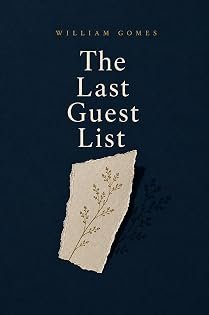
Mara has come to host a memorial for Helen Bowers, and she has prepared the way careful people prepare, completely. The guest list is her own draft. She knows the columns of the table plan by heart: family here, friends there, professional and other at the far end, every name where it should sit. Except that nothing is where she left it. The welcome speech has been moved to an earlier hour, before she arrived. Condolence cards have been hidden away. The lilies are wrong. And one card is worse than wrong: “Noor Bell was in the third column. Not the fourth. Not professional and other.” Noor Bell is a writer who barely knew Helen. Somebody has moved her card into the family column. Mara looks at it for a long moment. Then comes the quietest, most fateful gesture in the book: “She did not put the card back.” Another name, meanwhile, is missing altogether.
“She did not put the card back.”
The hotel keeps funeral weeks. It stands on the coast; it is October, the sea is outside and the rain is never far away. Helen knew the house well. Years before, she had taken the venue and set its funeral week rules, and the place still runs on her discipline. It has a character, this house: “The terrace door closed behind them with the deliberate click of a house that did not like to be hurried.” Mara must wait in it while other people hold pieces of the truth she needs, and the book finds the exact ache of that position: “Waiting was harder in a house that wanted to be useful to her.” To understand what Helen intended, she has to learn to read the house itself: its rooms, its cards, its envelopes and its silences.
The people Helen loved are gathered in it, and each of them is carrying something. Lydia, Helen’s partner of thirty-one years. Celia, her sister. Peter Ash, who carried one of Helen’s last letters, a keeping Mara knew nothing about: “Helen had not told me he had brought her a letter. She had not told me she had asked him to bring a letter.” Mr Rusk, the careful keeper of documents. Ellen Price, who understands the discipline of the desk. Nobody in the house holds the whole of Helen. Between them they hold pieces, and the pieces do not obviously fit.
Because Helen did not leave one secret. She left a system. Over time, carefully, she distributed her promises among the people around her: a letter carried by one hand, an arrangement known to another, a page kept back for a particular day. Even the table belongs to it. As the places are laid, a voice explains: “I have left the fifth setting un-laid because I had not yet had the name.” A setting left empty, for want of a name. In this novel a guest list is not administration. It is closer to a moral document: who is put inside the room, who is left outside it, and on whose say-so.
Nobody is murdered here. There is no suspect pool, and no reveal staged to make you gasp. The mystery is one of intention: what Helen meant, whom she meant it for, and which of her silences have to be honoured before they can be broken. The prose is built for listening. A knock at a door becomes an event, because the writing has taught you how to hear it: “The knock at the morning-room door came at the seventh count of the silence Mara had been holding.” Readers who like their fiction quiet and exact, who care about grief and family and the families people choose, will find this book waiting for them.
Philip Batty narrates the audiobook, and he is right for this house: unhurried, precise, happy to let a courtesy or a withholding land at its own pace. He opens where the novel opens, in the entrance hall, with the cards in the wrong order.
The Last Guest List is available in paperback and on Kindle, and as an audiobook on Audible. Read more about the book at its page: https://williamnicholasgomes.com/books/the-last-guest-list/. The Kindle edition is at https://www.amazon.co.uk/dp/B0H59863T8 and the paperback at https://www.amazon.co.uk/dp/B0H59H89GQ. The audiobook, narrated by Philip Batty, is at https://www.audible.co.uk/pd/The-Last-Guest-List-Audiobook/B0HLQ8GVLC. And if you would like to listen, William Gomes gives Audible promo codes for the audiobook free on request through his website, as a gift: no pressure, nothing asked in return, and no review expected. Just ask.
Watch the film: The Last Guest List by William Gomes

About the author
William Gomes is a novelist, poet and researcher. He writes about what the record leaves out: the people behind a verdict, a file, a form or a border. Read more about William Gomes.
Keep reading
The Woman in Room Nine: THE NINTH ROOM by William Gomes — Keep reading →
Listening for the Join: The Raincoat Witness by William Gomes — Keep reading →