The Keeping of the House: Placement, Promise and the Ethics of Attention in The Last Guest List
This essay offers a critical analysis of The Last Guest List by William Gomes. It argues that the novel replaces the detective’s question with the host’s: placement is read as a moral act, restraint as a form of agency, and grief as a practice to be inherited rather than a feeling to be expressed. Reading the novel’s table plan, its unreplaced card and its house of funeral weeks as a single system of distributed keeping, the essay considers what the quiet literary mystery can do that the conventional detective novel cannot.
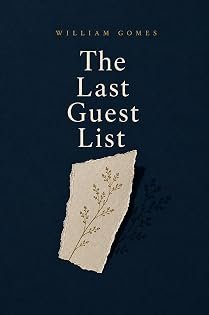
The Last Guest List is a literary mystery that begins not with a death but with a disturbance of arrangement, and everything in it follows from that choice. The novel, my own, is set across a single funeral week in a coastal house that keeps such weeks as its trade, and it asks a question the detective novel usually refuses: not who did it, but what was intended, and for whom. Helen Bowers, in whose memory the memorial is held, is dead before the action opens, and yet she is the book’s presiding intelligence, because she has left her last wishes distributed among the living as a system of partial keepings: letters carried by one hand, arrangements known to another, a page kept back for a named day. No one person holds the whole of her. The essay that follows argues that this distribution is not a device laid over the novel’s meaning but the meaning itself: that The Last Guest List is a study of placement as a moral act, of restraint as a form of agency, and of grief understood not as a feeling to be expressed but as a practice to be inherited. It is available in paperback and on Kindle, and as an audiobook narrated by Philip Batty, whose unhurried reading suits a book in which a knock at a door can carry the weight of a chapter.
An opening in the wrong order: the anti-detective premise
The first sentence announces an epistemology. “Mara Vale came into the entrance hall at twenty past nine and saw at once that the table cards had been set out in the wrong order.” Nothing has been stolen, threatened or broken. Something has been placed wrongly, and the novel’s first demand on its reader is to accept that placement is evidence. Mara Vale, who is hosting the memorial and who knows the table plan by heart, finds the morning’s arrangements altered at every point she tests them: a welcome speech moved to an earlier hour, condolence cards hidden away, the lilies wrong. And one alteration is worse than wrong. A guest who barely knew Helen, the writer Noor Bell, has been moved in the plan from the outer category to the family’s own column: “Noor Bell was in the third column. Not the fourth. Not professional and other.”
The sentence is worth pausing over, because the whole method of the book is in it. The information arrives as a correction of position, stated in the negative, in the flat vocabulary of a seating plan; and yet it is charged, because in this house a column is not an administrative convenience but a claim about who somebody was to Helen. To move a card is to rewrite a relationship. The detective novel opens by disordering the world with a crime and promising to restore order with a name. The Last Guest List opens by disordering a table and promises nothing of the kind. Its mystery is one of intention, and intention, unlike guilt, cannot be proved by a single disclosure. It can only be approached, piece by piece, through the people Helen chose to hold the pieces. The reader who comes looking for a culprit will find the book withholding in a way that may at first feel like slowness. It is not slowness. It is the subject.
The ethics of the unreplaced card: restraint as action
Mara’s defining acts are non-acts. Faced with the moved card, she looks at it for a long moment, and then: “She did not put the card back.” Five words, and the novel’s moral grammar is established. In a house where every alteration of the morning has been made by somebody’s hand, the discipline of not acting becomes the strongest available form of agency, because to put the card back would be to decide, unilaterally and in ignorance, what Helen meant. Mara’s restraint is not passivity and the book is careful to price it. Waiting, in these pages, is labour: “Waiting was harder in a house that wanted to be useful to her.”
That sentence catches the exact ache of the host’s position. The house is full of people and mechanisms ready to help her, and every offer of help is also a pressure to conclude, to settle the arrangements, to let the weekend proceed as weekends proceed. Her investigation, if the word can be stretched to cover it, consists largely of refusing that pressure at the right moments: doors stood at and not opened, an envelope found and not opened, questions carried unanswered for chapters at a time. Critics of the quiet novel sometimes mistake this register for an absence of event. The opposite is true. In a book where a card left unreplaced is a decision, the moral resolution of the prose has been turned up until courtesy itself becomes legible as action, and a withholding lands with the force that another novelist would need a confrontation to achieve.
The house as system: funeral weeks and the discipline of forms
The setting is not a backdrop. The house on the coast keeps funeral weeks; it has rules for them, hours, desks, standing forms, a discipline evolved over years for holding grief at a bearable rate. Those rules were Helen’s. She took the place years before and set its order, and the house still runs on her design, which makes it, in effect, her continuing authorship: a mind still operating after its owner has gone, in timetables and furniture. The prose grants the house preferences and habits of its own: “The terrace door closed behind them with the deliberate click of a house that did not like to be hurried.”
That click is characteristic. The house is allowed a temperament because the novel understands institutions, even small and kind ones, as frozen intentions. To read the house correctly, its rooms, its cards, its envelopes, its silences, is to read Helen by the only text she fully controls after death: the arrangements she left running. This is why the book’s attention to procedure never feels like padding. Procedure is character here, Helen’s character, preserved in the conditional tense of a well-run house, and Mara’s education is learning to read it without presuming to rewrite it.
The guest list as a moral document: columns, placement and chosen family
The table plan’s columns, family here, friends there, professional and other at the far end, are the novel’s social ontology set out in card. The title’s full weight rests on this: a guest list, in The Last Guest List, is the most honest autobiography a person leaves, because it records not what she said about her relationships but where she actually put them. Every name on the plan is a judgement Helen made, or that someone has since presumed to revise, and the weekend’s quiet disturbances are all, at bottom, disputes about placement: who belongs inside the room, who has been left outside it, and on whose authority.
The purest case the book offers is an absence. A setting at the table has been deliberately left unmade, belonging decided in advance for a person not yet identified, and the voice that explains it gives the novel one of its defining sentences: “I have left the fifth setting un-laid because I had not yet had the name.” Consider what that reverses. Ordinarily a place is laid because a person is known; here the place is held open in faith that the person exists, kinship treated as an act of placement rather than a fact of blood. The literature of chosen family often announces itself. This novel simply builds the idea into its furniture and lets the reader notice, as Mara notices everything, a little at a time. Belonging, the book proposes, is something the living do for one another with their hands, at tables, in advance of certainty.
Distributed truth: letters, keepings and partial knowledge
Helen’s system is an epistemology before it is a plot. Knowledge of her intentions exists only in pieces, held by different keepers under different conditions, and the novel is rigorous about the consequences: no keeper can check their piece against the whole, because there is no whole available to anyone. Mara learns, well into the weekend, that a letter reached the house by a hand she had not suspected, and that Helen had kept the errand from the person closest to her: “Helen had not told me he had brought her a letter. She had not told me she had asked him to bring a letter.” The doubling of the sentence is the wound and the method at once. What hurts is not the letter but the distribution, the discovery that intimacy did not entitle anyone to completeness.
Elsewhere the conditions are stated as terms, almost as contracts. An envelope may be read, but only in company: “I will read it with you. I will not read it without you.” And the system’s reach extends absurdly, tenderly far into the future: “The blank page had been kept by Helen for the Monday after the second day of a funeral week.” A blank page, kept for a specified Monday. The detail is funny and desolate in equal measure, and it tells the reader exactly what kind of mind designed this weekend: one that trusted paper, timing and other people more than it trusted any single person’s judgement, including its own. Trust, in this novel, is not a feeling. It is a structural property of the design, and each keeper’s partial ignorance is itself one of Helen’s decisions, to be honoured rather than circumvented. Testimony without a centre: that is the book’s real architecture, and it is why the reading experience feels less like pursuit than like being gradually, carefully trusted.
Silence as evidence: the unsaid, the unnamed, the unopened
Silence in The Last Guest List is not the absence of information but one of its forms, with its own etiquette, gradations and evidentiary weight. Names are withheld, or given only by telephone, or carried without paper at all. Questions are answered by being declined at exactly the right depth, and the decline, correctly read, is the answer. Mara’s apprenticeship, across the funeral week, is learning to make that reading: “She had not, until this morning, known that a silence could be the answer to a question.”
The risk in such a method is obvious, and the book knows it: a fiction that treats silence as evidence can cheat, letting the unsaid mean whatever the author needs. Gomes guards against it by discipline. Silences in this novel are never blank; they are placed, timed and witnessed, as precisely as the table cards, and they cost the people who keep them something visible. A silence that costs nothing would be mere coyness. These are closer to a form of custody. What is not said is being kept, the way the letters are kept, and the reader is asked to extend to the characters the same courtesy Mara extends to the house: to attend before presuming.
A prose that listens: syntax, counting and the object world
The style is the argument at sentence level. The prose works in short declarative units, in constructions that define things by what was not done, and in time counted out with unusual exactness: quarter hours, appointed hours, silences held to a number. Its signature moment is a knock: “The knock at the morning-room door came at the seventh count of the silence Mara had been holding.” An event made entirely of attention. Nothing in the sentence describes the person knocking, and nothing needs to; the drama is in the counting, in a woman measuring her own composure and being interrupted at the seventh beat of it.
Meanwhile the object world carries the evidentiary and emotional load that dialogue declines to carry. Cards, plates, pages, lamps, chairs: the novel’s feelings live in its furniture, which is why its descriptions repay the slow reading the book demands. This is prose built for listening as much as for reading, and it explains why the audiobook, narrated by Philip Batty with the patience the text requires, is such a natural form for it. Batty lets a courtesy or a withholding land at its own pace, and in this book pace is meaning.
Inheritance of a practice: keeping as the novel’s answer
What passes from Helen to Mara is not property, and not finally information either. It is a practice: a form of holding, of people, papers, hours and houses, that those who watched Helen for years recognise when they see it again. A keeper, asked where she stands in relation to the woman whose place she has taken at the table, answers with the novel’s most compressed statement of its theme: “I am, she said, where she sat.” Identity, here, is positional and practical. You are where you sit, which is to say, you are the place you keep for others. And the recognition runs both ways. “I know the form of yours.” The words are spoken to Mara: the form of a holding identified across twenty-five years of watching, as one craftsperson recognises another’s hand.
This is the novel’s answer to the question its premise poses, and it is deliberately not a solution. The dead, the book proposes, are kept not by answers but by continued practice, and grief, properly understood, is a discipline with mornings and afternoons in it. A hostile examiner might object that the withholding of solution-shaped satisfaction is a refusal of the mystery genre’s contract. The objection deserves its answer: the contract is not refused but rewritten, in full view, from the first displaced table card. What the reader is offered instead of a culprit is rarer and, I would argue, harder to bring off: the spectacle of a practice being inherited, act of restraint by act of restraint, until the keeping itself becomes the plot.
Coda: the book’s place
Within contemporary literary mystery, The Last Guest List belongs with the quiet, exact end of the genre, the fiction that trusts arrangement, testimony and the moral weight of small objects over shock. Within the literature of mourning, it is distinctive for treating grief as governance: the question is never only how the bereaved feel, but who holds what, and when, and under what conditions it may be opened. And within my own catalogue it is the book in which a recurring subject, what the record cannot hold, is given its most domestic and most exact form: a table, a house, a list of names, and the discovery that the list was the story all along. Readers who care about family and the families people choose, and who like their fiction patient, precise and built to be listened to, will find it waiting for them.
Editions and availability
The Last Guest List is available in paperback and on Kindle, and as an audiobook on Audible. Read more about the book at its page: https://williamnicholasgomes.com/books/the-last-guest-list/. The Kindle edition is at https://www.amazon.co.uk/dp/B0H59863T8 and the paperback at https://www.amazon.co.uk/dp/B0H59H89GQ. The audiobook, narrated by Philip Batty, is at https://www.audible.co.uk/pd/The-Last-Guest-List-Audiobook/B0HLQ8GVLC.
The author gives Audible promo codes for the audiobook free on request through his website, as a gift: no pressure, nothing asked in return, and no review expected.

About the author
William Gomes is a British author and critic based in York, England. He is the author of eighty-four books: sixty-three novels, ten collections of poetry, nine devotional works and two works of non-fiction, many of them also published as audiobooks. His fiction and criticism return to questions of faith, grief, memory and conscience, and to the people institutions overlook; his novel What the Record Cannot Hold draws on autism, special educational needs and a father’s advocacy for his son. He writes the critical articles on his own books published alongside them at williamnicholasgomes.com. Correspondence concerning this article should be addressed to william@williamnicholasgomes.com.
How to cite this article
Gomes, W. (2026) ‘The Keeping of the House: Placement, Promise and the Ethics of Attention in The Last Guest List’, williamnicholasgomes.com. DOI: https://doi.org/10.5281/zenodo.24634788
The article as published (PDF)
Keep reading
The Names Left Behind: The Last Guest List by William Gomes — Keep reading →